

Why Every Circuit Deserves Its Own Safety Switch in Your Woy Woy Home
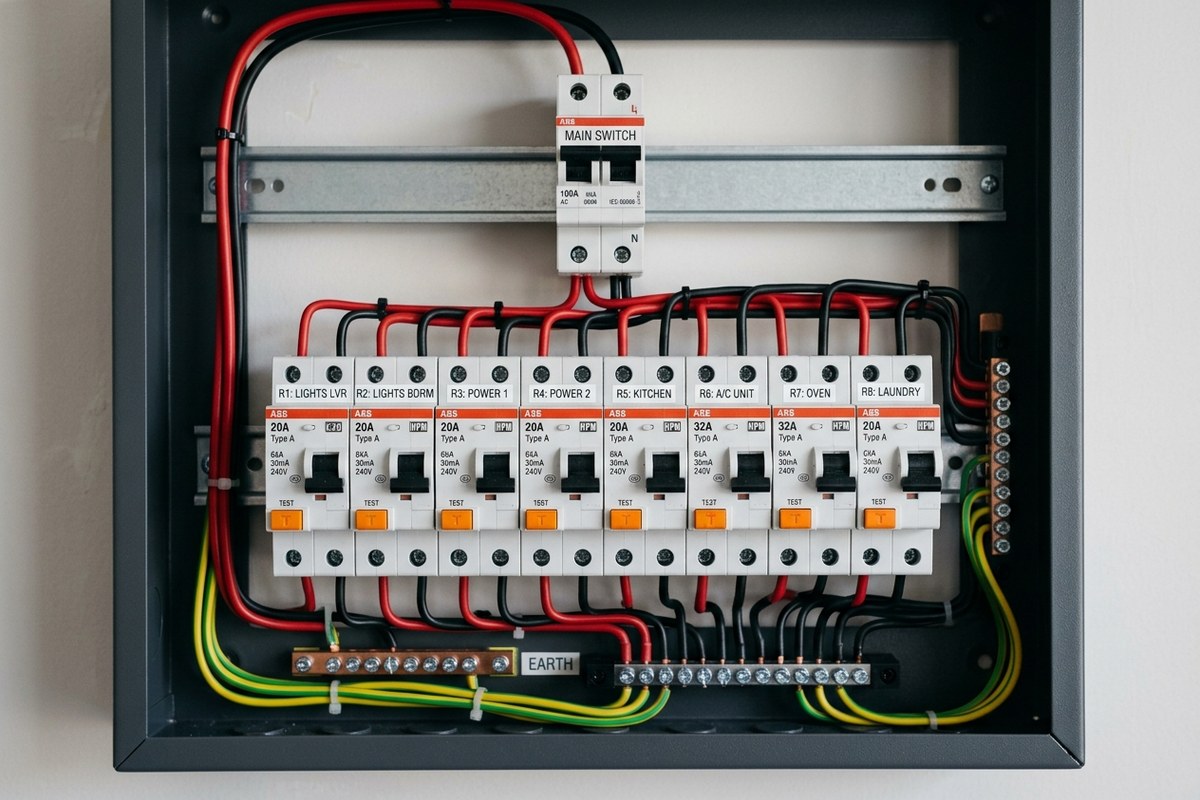
Most people know they're supposed to have a safety switch, and many assume that one ticked box on the switchboard covers the whole house. The reality is more nuanced, and for a home on the Woy Woy peninsula it's worth understanding the difference, because how safety switches are arranged across a switchboard has a direct bearing on how well a household is protected and how much disruption a fault causes.
What a safety switch actually does
A safety switch, properly called a residual current device, or RCD, constantly compares the electricity flowing out to a circuit with the amount flowing back. If even a small difference appears, which can happen when current leaks through a person or into water, it cuts the power in a fraction of a second. That speed is what protects against a fatal electric shock. It's a fundamentally different job from a circuit breaker or fuse, which protects the wiring from overload and short circuits but does little to protect a person from shock.
Why one safety switch for the whole house falls short
Older installations sometimes have a single safety switch covering several circuits, or rely on circuit breakers alone with no RCD protection at all. Both arrangements have drawbacks. With circuit breakers alone, there's no fast shock protection where it counts. With one shared safety switch, a fault anywhere, a failing appliance, a nicked cord, moisture in an outdoor point, trips the entire house, plunging everything into darkness and making it hard to tell which circuit caused the problem. On the coast, where salt and moisture make outdoor and wet-area faults more likely, that whole-house tripping can become a regular nuisance.
The case for protecting each circuit individually
The modern approach is to protect circuits individually, typically with combined devices known as RCBOs that bundle safety-switch and circuit-breaker protection into one unit per circuit. The benefits are clear. A fault on one circuit trips only that circuit, so the rest of the house keeps running, the fridge stays cold, the lights stay on, and the fault is far easier to pinpoint. Every circuit gets genuine shock protection rather than just the few that happened to be wired through the shared device. For households with children, medical equipment, or simply a freezer they'd rather not lose, that resilience matters.
What the rules require
Australian wiring rules have progressively expanded the requirement for RCD protection, and circuits added or altered today generally must be protected. An older home that hasn't been touched in decades may have far less protection than current standards call for, and while existing installations aren't always forced to upgrade immediately, any significant electrical work is a natural and sensible trigger to bring things up to a safer standard. An electrician can assess what's currently protected and what isn't.
What an upgrade involves
Fitting individual safety switches usually means work at the switchboard, and in older homes the board itself may be too full or too dated to accept modern devices, in which case a switchboard upgrade is part of the job. A licensed electrician assesses the existing board, the number of circuits and their condition, then installs the appropriate protection and tests every device to confirm it trips correctly. It's typically a same-day job for a standard home, and the result is a switchboard that's safer, clearer to read, and easier to live with when something does go wrong.
A worthwhile investment in an older peninsula home
Many of the established homes around Woy Woy and the wider peninsula were wired long before individual RCD protection was standard. Bringing the switchboard up to date is one of the higher-value safety upgrades available, both for the genuine protection it adds and for the everyday convenience of faults that isolate themselves instead of blacking out the whole house. For anyone renovating, buying, or simply tired of the whole home tripping at once, it's a sound place to start.
Frequently Asked Questions
Isn't one safety switch for the house enough?
It's better than none, but a single shared safety switch means any fault trips the whole home and not every circuit may be covered. Protecting each circuit individually gives fuller protection and far less disruption.
What's the difference between a safety switch and a circuit breaker?
A circuit breaker protects the wiring from overload and short circuits. A safety switch (RCD) protects people from electric shock by cutting power the instant it detects current leaking to earth. They do different jobs, which is why both matter.
Do I legally have to upgrade my older switchboard?
Existing installations aren't always required to upgrade immediately, but current rules require RCD protection on new and altered circuits. Any significant electrical work is a good time to bring protection up to standard.
How long does it take to add safety switches?
For a standard home it's often a same-day job, though if the existing switchboard is full or outdated it may need upgrading at the same time. An electrician can confirm after inspecting the board.
Talk to a Local Central Coast Electrician
Want every circuit properly protected? A local Woy Woy electrician can check your switchboard and fit safety switches across your circuits so a fault on one doesn't put the whole home at risk.